Why your strategy is a dead fish
Our Strategy Partner Shruti Rai recently joined host Robin Scarborough on Episode 6 of The Match*, StudioSpace's podcast series with the leaders of independent agencies. The episode is titled Why Your Strategy Is a Dead Fish. This is the argument behind it.*
The most expensive artwork in your organisation
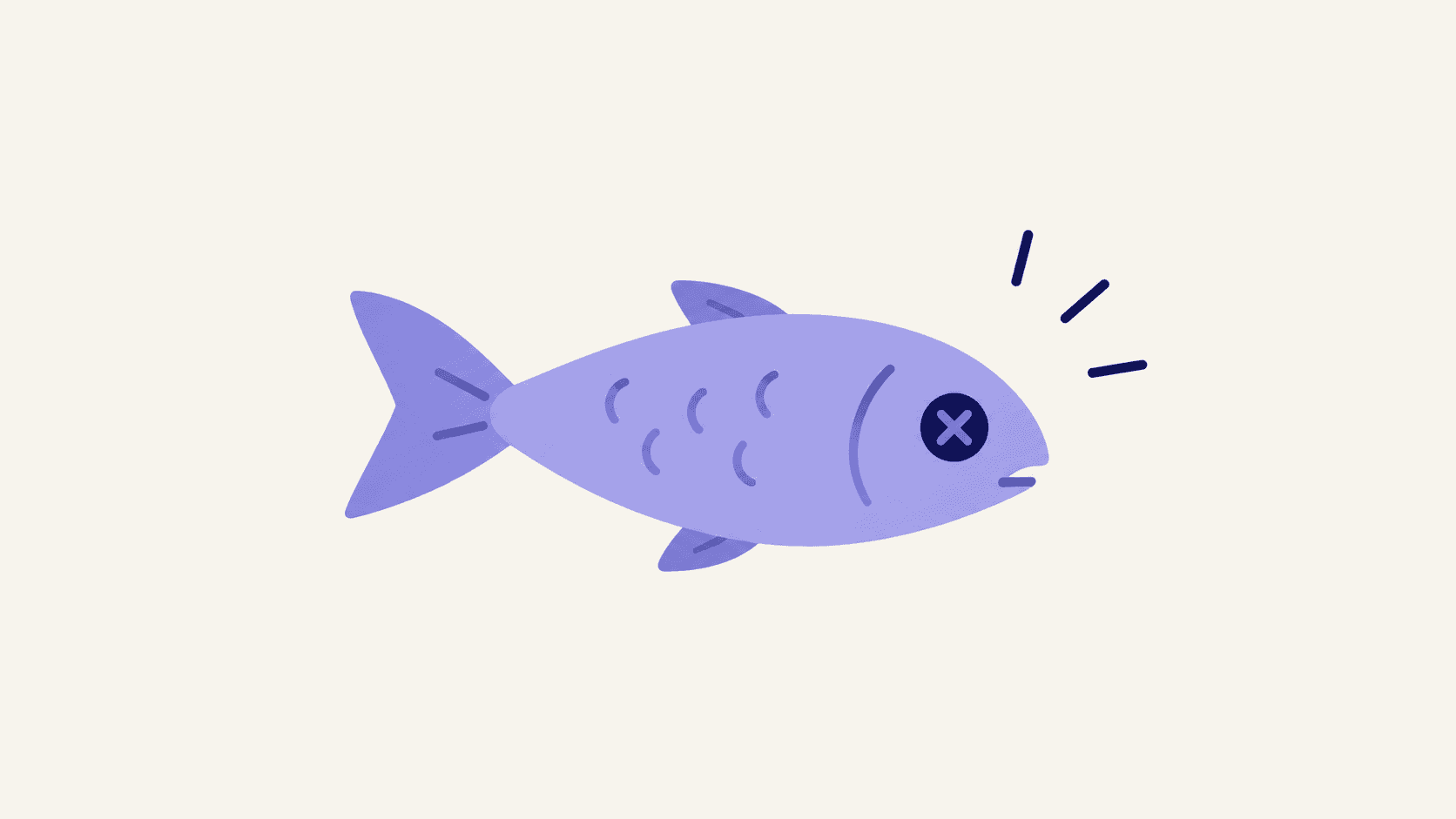
Ask someone to draw a fish and they'll produce something recognisable, static and quite dead. It has the shape of a fish and none of its behaviour. That's not a failure of the artist. It's a failure of the medium. Paper only allows one kind of fish.
Now apply that to strategy. The reason so many organisations end up with 90-to-200-page strategy documents is that we design strategy around how it will be communicated — a PowerPoint — rather than how it will be used. As Shruti put it on the episode, those documents are "very expensive artwork". Beautiful, smart, good to look at. But alive?
Here's the part that should worry any executive who has commissioned one. Enormous richness goes into a strategy: interviews with the business, with stakeholders, with customers; market research; competitor analysis; hard-won internal knowledge. And then, in Shruti's words on the podcast, "all of that richness boils down to ten flat pages. All of that richness boils down to one dead fish."
The concept comes from a talk by the designer and technologist Bret Victor, who argued that the medium shouldn't dictate the output — paper shouldn't be the reason we draw dead fish. His deeper point matters more for strategy: the person interacting with the thing is also alive. The question becomes how you orchestrate a performance between two live creatures.
Translated into our world: what's the right way to bring strategy to life so that the humans who have to use it — your teams — can interact with it and make clearer decisions, faster?
Why 2026 makes this urgent
There was a time when the six-month strategy project made sense. You'd go away, do deep research, come back and present exactly what should happen across the next two horizons. Find the thing that works, optimise, scale. Six Sigma. That was the playbook.
That playbook doesn't hold anymore, whether you're a complex enterprise or an early-stage business. Very few organisations now have the luxury of marinating in thinking before they execute. The strategy function itself has to move at the speed of the landscape it's describing.
And yet, as Shruti noted on the episode, we're in 2026 and still largely buying strategy as decks.
GHO CoLab: the antidote
GHO CoLab began as a direct response to the dead fish problem. We're a studio of thinkers and makers where most of our strategists were designers, or are designers with a strategic lens, so the instinct was never to describe the answer. It was to build it.
Instead of handing over a 200-page document, a GHO CoLab runs a different sequence: initial research, then casting the right people from the client's own team, co-creating with them, prototyping, and testing with real customers.
"What would otherwise have been a dead-fish strategy deck is now a working prototype — tested, and brought to life as a business case." — Shruti Rai, The Match, Episode 6
The difference in the room is momentum and ownership. Rather than telling a stakeholder this was our hypothesis, you show them what you built, and how customers responded, validated for value, viability and feasibility inside a short span of time. That's a very hard thing to say no to.
We've now run 50+ GHO Colabs, with organisations including CommBank and Allianz. What was once a considered sell is now something clients come to us asking for by name.
Two examples from the episode
CommBank: "How might we be relevant to the youth?"
The retail team was losing the halo effect of a generation that grew up with Dollarmites, while younger audiences, who'd never heard of it, saw CommBank as something that belonged to Mum and Dad. They wanted something more relevant for how young people actually learn about money.
The GHO Colab ran research, brought the right people together, co-created multiple solutions, prototyped with our designers and tested with young customers. The insight wasn't a feature list. Ask young people what they want and they'll say "an app" — but the bank already had an app. What surfaced was how they think about money, and what it would take to help them learn the fundamentals from the start.
Then came the part that matters most about co-creation: the product team in the room started saying "that should be on our roadmap." A feature was released into the app within months, while the marketing team walked away with a value proposition to take to market. As Shruti framed it, an alive strategy is something everyone around the table can take something from — not just the team that commissioned the work.
SG Fleet: from asset provider to mobility provider
A whole-of-business future vision, and the harder test of the approach. SG Fleet's ambition was to make the leap from providing 200,000 vehicles to providing mobility services. What does that actually mean — for how the service is described, for the experience, for the market?
Because the offering spanned B2B, B2B2C and B2C, we ran a Collab per audience. Across three Collabs we built the future vision as a prototype and brought it to life across online and offline experiences, testing with employers and employees before it went to stakeholders. It made "mobility provider" tangible rather than aspirational.
Compare that to a 200-page document seen only by the most senior stakeholders. It would have taken far longer to cascade down to the BDM or the customer service team. Instead, the business already had champions of change who could own the strategy — because they'd helped build it.
What you need in place
The approach isn't a black box, and it isn't for every situation. Where deep rigour is genuinely required, government projects for instance, where every decision and hypothesis needs to be evidenced, youmust take the time and get the detail in.
For everything else, three ingredients:
A clear enough problem. Not a perfect one. Sometimes clients need help defining what's actually worth solving, and that's part of the work.
A real understanding of the audience and the why. Plus enough pre-work that we arrive up to speed on a problem you've been living in.
The right people in the room. We're not experts in your business; we're domain experts in the process. The magic comes from combining an external point of view with your internal experts. You need legal to get a new service out. You need customer service, because most executives sit in ivory towers and it's the frontline who know exactly where the pain is. We've had people arrive on day one asking "what am I doing here?" — and watched the chemistry between people in the same company who'd never met become one of the most valuable things in the process.
The AI question we're actually asking
Everyone is asking what AI does to design. We're more interested in what AI does to strategy.
The literal answer is speed: from here's our thinking, to here's our hypothesis, to here's how we make it, to here's how we build it — thinking into a built environment and piloted with real customers, quickly. Figma was a turning point for us for exactly this reason. Most read it as a design moment; we read it as a strategy moment, because it meant a Collab could put a prototype rather than a deck on the table.
But the more interesting question sits further out. All that richness that goes into developing a strategy — particularly brand strategy, where a business that hasn't examined itself in a decade is effectively reintroducing itself to who it is — how do we operationalise that so it stays dynamic and executable for whoever picks it up, even three years after the project ends? How do you make the strategy itself a living asset inside the organisation?
That's where GHO is heading.
Three questions for your last strategy document
If you're sitting on a months-long research project right now, start here. Pull out your most recent strategy document and ask:
- Was it dynamic? Did it hold true through the factors that shifted after it was written?
- Did it deliver outcomes your teams understood? Not just outcomes — outcomes people could name.
- Was it executable? Strategy is meant to give you a framework of choices. Did it help you make better ones?
If the answer is no, you have two options. Frame it as artwork. Or change how you buy strategy next time.
Because the thing worth remembering, in Shruti's words: "When you're thinking about buying strategy, you're not buying a document — you're buying a way of bringing a solution to life."
Listen to the full conversation: Why Your Strategy Is a Dead Fish — The Match, Episode 6, with Shruti Rai and host Robin Scarborough. Also available on Spotify.
Curious what a Collab would look like for a problem on your desk? Get in touch — or view GHO Sydney on StudioSpace.